Electric distribution asset hierarchy template
A worked example of an electric distribution asset hierarchy: 21 classes in 4 levels, 23 data points and 14 decisions, each linked to the lifecycle stage it supports. It's a starting point built on general industry practice, not on any organization's real data.
Opens as your own editable copy. Nothing to sign up for.
- classes
- 21
- levels
- 4
- data points
- 23
- decisions
- 14
- lifecycle stages
- 6
The levels
4 levels, from the whole network down to the part you maintain. Rename them to suit.
| Level | What it holds |
|---|---|
| 1. System | The whole network or portfolio. Holds the data points every asset shares. |
| 2. Asset group | A family of assets that are managed, budgeted and reported together. |
| 3. Asset class | Assets alike enough to share a design life, an inspection regime and a cost model. |
| 4. Component | A part that is inspected, maintained or replaced on its own schedule. |
The full class outline
Every class, with the data points it defines in italics. A class passes its data points to everything beneath it.
- Electric distribution systemEvery asset that delivers power from the substation to the customer.the shared data points below
- SubstationsFacilities that step voltage down and switch circuits.
- Distribution substationA substation feeding distribution circuits.
- Power transformerSteps transmission voltage down.Rated capacity, Dissolved gas analysis
- Circuit breakerInterrupts faults.Operation count
- Protective relayDetects faults and trips breakers.
- Battery systemBackup DC power for protection.
- Distribution substationA substation feeding distribution circuits.
- Overhead linesConductors and structures above ground.Circuit ID
- PoleWood, steel or concrete pole.Pole material, Remaining strength
- ConductorOverhead wire.Conductor size
- Overhead transformerPole-mounted transformer.Peak loading
- Overhead switch and recloserSectionalizing and automatic reclosing devices.
- Underground systemCable and equipment below ground.
- Underground cablePrimary and secondary cable.Insulation type, Fault count (5 years)
- Pad-mounted transformerGround-level transformer.
- SwitchgearUnderground switching cabinets.
- VaultUnderground enclosures.
- Right of wayCorridors that must be kept clear.Last trim date
- Vegetation spanA span of line with trees nearby.
- MeteringCustomer meters.
- Customer meterRevenue meter.Meter type
- SubstationsFacilities that step voltage down and switch circuits.
The shared data points
11 data points defined once, on Electric distribution system, and inherited by every class. Each one carries a reason: the decisions it feeds.
| Data point | Type | Feeds decisions |
|---|---|---|
| Install dateStarts the asset's life clock. Age, remaining life and renewal timing are all calculated from it. | date | As-built acceptance, Long-term financial forecast |
| AgeGroups assets by vintage for inspection planning and replacement forecasting. | number · years | Inspection frequency, Long-term financial forecast, Retire or abandon |
| Expected useful lifeThe design or industry life for this class. Sets when renewal should be planned. | number · years | Long-term financial forecast, Capital renewal program |
| Remaining useful lifeHow long the asset can keep serving. The basis for the renewal year and the repair-or-replace call. | number · years | Capital renewal program, Repair, rehabilitate or replace |
| Condition scoreMeasured physical state, 1 (very good) to 5 (very poor). Drives inspection, maintenance and renewal decisions. | number · 1–5 | Inspection frequency, Maintenance strategy, Repair, rehabilitate or replace, Retire or abandon |
| Likelihood of failureHow likely the asset is to fail, from condition, age and failure history. Half of the risk score. | number · 1–5 | Risk ranking |
| Consequence of failureHow much a failure would cost in safety, service, environment and money. The other half of the risk score. | number · 1–5 | Risk ranking, Inspection frequency, Maintenance strategy |
| Risk scoreLikelihood times consequence. Ranks assets so money goes to the highest risk first. | number · LoF × CoF | Risk ranking, Capital renewal program, Repair, rehabilitate or replace, Retire or abandon |
| Replacement costWhat it would cost to replace today. Feeds the capital plan and the long-term forecast. | number · $ | Capital renewal program, Long-term financial forecast, Repair, rehabilitate or replace |
| Planned rehab / replace yearThe year renewal is planned. Turns risk and remaining life into a schedule and a budget. | number · year | Capital renewal program, Long-term financial forecast |
| PM / CM ratioShare of maintenance hours that were planned rather than reactive. Shows whether the maintenance strategy is working. | number · % | Maintenance strategy |
The decisions, and the lifecycle stages they sit in
9 decisions are shared by every template and 5 are specific to this one. The lifecycle runs Plan, Create, Operate, Maintain, Renew and Dispose.
| Decision | Stages | Kind |
|---|---|---|
| Risk ranking | Plan › Needs assessment | Shared |
| Capital renewal program | Plan › Capital planning, Renew › Replace | Shared |
| Long-term financial forecast | Plan › Capital planning | Shared |
| Design standards | Create › Design | Shared |
| As-built acceptance | Create › Construct | Shared |
| Inspection frequency | Operate › Inspect | Shared |
| Maintenance strategy | Maintain › Preventive | Shared |
| Repair, rehabilitate or replace | Maintain › Corrective, Renew › Rehabilitate, Renew › Replace | Shared |
| Retire or abandon | Dispose › Decommission | Shared |
| Vegetation management cycle | Maintain › Preventive | Industry |
| Pole replacement priority | Plan › Needs assessment, Renew › Replace | Industry |
| Transformer loading review | Operate › Monitor | Industry |
| Outage restoration priority | Maintain › Corrective | Industry |
| Reliability improvement plan | Plan › Capital planning | Industry |
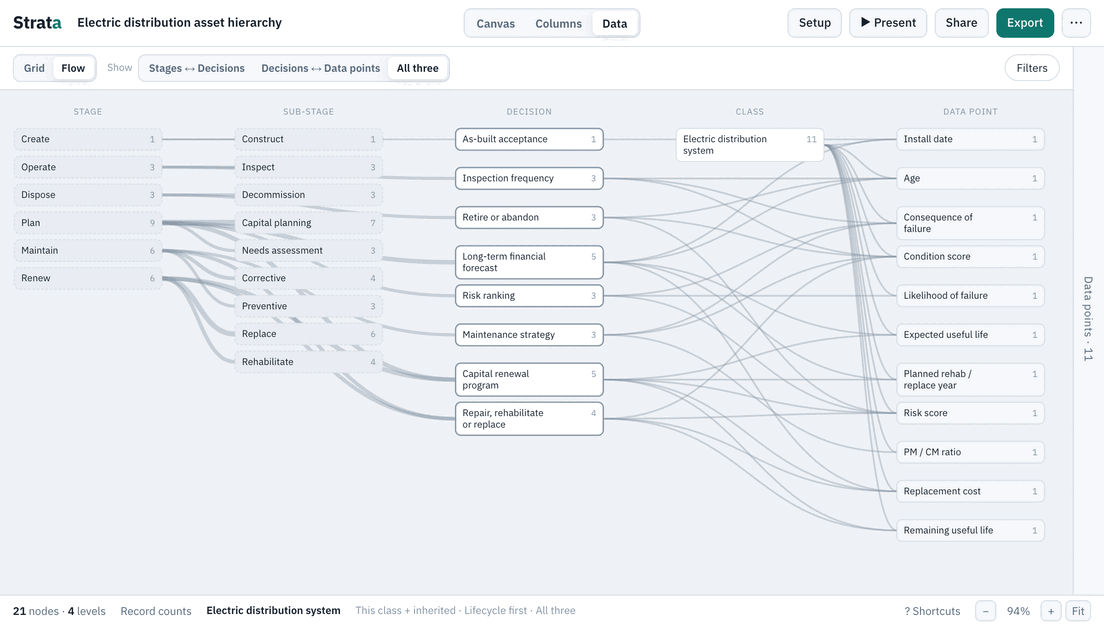
The Flow map
The same template as a Flow map: lifecycle stages, the decisions made in them and the data points each one needs.
How to make it yours
- 01
Rename the levels
Open Setup › Levels and call each level what your organization calls it.
- 02
Add your classes
Add the classes you have that the template does not, or import your own list from Excel. Anything you add inherits the shared data points from its parent.
- 03
Link your own decisions
Open Setup › Decisions to change which decisions each data point feeds and which lifecycle stages they sit in. Gaps are counted for you.
Open the electric distribution template and make it yours.
Opens as your own editable copy. Nothing to sign up for.