Asset information requirements for capital planning
Leadership asks how many assets, and which data, sit behind each dollar of the capital request. Asset information requirements are the answer written down: for each decision, the data points it needs. Here is how to build them, starting from the question.
Published 2026-10-09 · Theory only: general industry knowledge, no client data.
The mismatch
Leadership asks decision questions. How many assets do we have, and which data sit behind each dollar of the capital request? Can we say what condition they are in? The systems answer a different question, which is what was collected, by whoever collected it, for whatever reason applied at the time.
Asset information requirements close that gap. They are a written statement of what information the organization needs about its assets to run them, tied to the decisions that use it. ISO 19650, from the built-environment world, uses the terms organizational information requirements and asset information requirements. ISO 55001 asks an organization to determine what information its asset management needs. Neither tells you the list. You build it, and it does not need to be a 400-row spreadsheet.
Maximo is IBM’s product. The name belongs to its owner, appears here only so you can tell what this guide is about, and Strata is not affiliated with IBM. Strata does not connect to your work order system (Maximo, for example) or your GIS, and it does not hold the asset records or calculate dollars. It shows which data a decision depends on and whether you can trust it. Your systems hold the values.
A worked example: the capital request
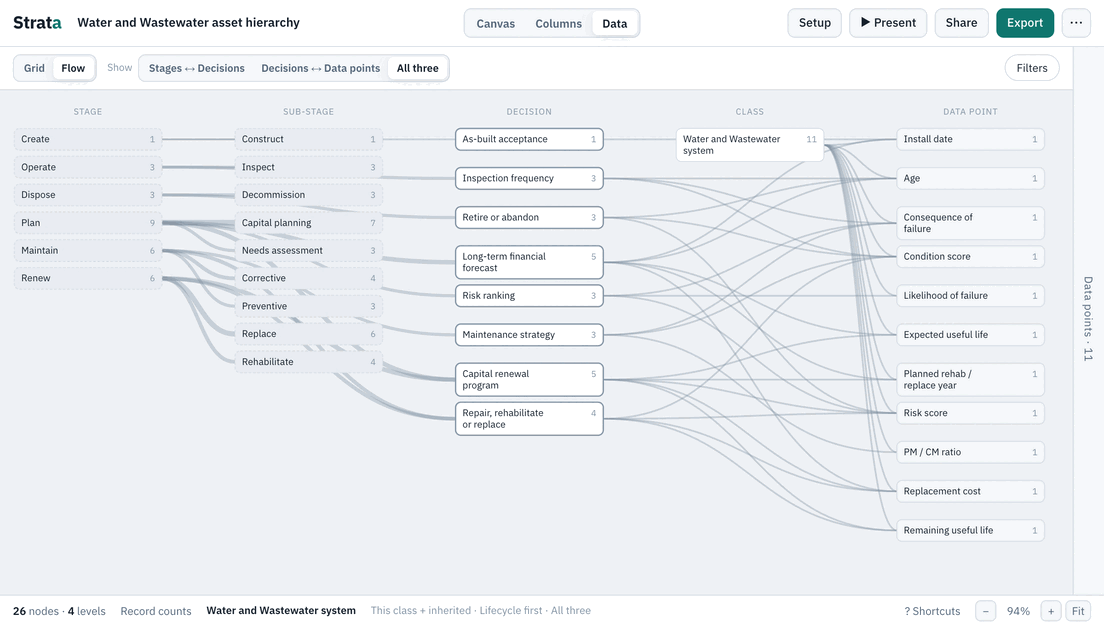
Start from the question, not the data. “What are we asking to spend on capital next year, and what stands behind it?” In the Water and Wastewater template that question lands on two decisions. Capital renewal program happens in Plan › Capital planning and Renew › Replace, once a year, and the decision maker is a manager. Repair, rehabilitate or replace is event-driven, sits in Maintain › Corrective, Renew › Rehabilitate, Renew › Replace, and the decision maker is an engineer / analyst. Between them they depend on 11 data points. Four carry most of the weight.
| Data point | Why it exists | Collected by |
|---|---|---|
| Condition score | Measured physical state, 1 (very good) to 5 (very poor). Drives inspection, maintenance and renewal decisions. | Field inspection |
| Remaining useful life | How long the asset can keep serving. The basis for the renewal year and the repair-or-replace call. | Calculated |
| Risk score | Likelihood times consequence. Ranks assets so money goes to the highest risk first. | Calculated |
| Replacement cost | What it would cost to replace today. Feeds the capital plan and the long-term forecast. | Calculated and Manual entry |
Risk score is built from two more, Likelihood of failure and Consequence of failure, so the requirement reaches them too. And the first question still hides a second one: how many assets of each class are there? The data points describe each asset, and a count tells you how many times the request multiplies them.
Five checks for every data point
- Where is it captured? On the work order when a crew closes it, on an inspection, in a GIS edit, or calculated later.
- Which system holds the master copy today, and which should?
- Is it captured and trusted, captured but needing cleanup, partly captured, or missing?
- Who owns it, meaning who is asked when it looks wrong?
- Does it cover every class the decision applies to?
Strata gives each of these a place. Collected by, Current state and Data owner are fields on every data point, and Current system and Desired system sit beside them. Collected by comes with six choices (field inspection, sensor or SCADA, design records, manufacturer data, calculated, manual entry). None of them says work order, so if that is how your crews capture it, add a choice under Setup, Fields. Current state starts blank in every template, because filling it in is the exercise.
Break history shows why the question matters. Break count (10 years) feeds Pipe renewal priority and Risk ranking, and the template records it as field inspection. In practice such a count is only as good as the failure details that get entered when a repair work order is closed. If crews can close one without them, the count undercounts, and a risk ranking built on it quietly favors the pipes nobody wrote up.
Counts, and keeping two systems in step
Strata can hold an approximate count on each class, as a total or per parent, and its record projection adds the levels up. Use it to show the shape of the system: thousands of regulator stations or a few hundred pump stations. It is not an asset register, and the figure that matters is the one in your GIS and your work order system.
Whether those two agree is a reconciliation, and it happens in your systems. Strata can say which one is meant to be the master for each data point, which is the part most organizations never write down. Without it, two systems each hold a version of Length or Material and the capital request inherits whichever one the analyst opened.
Asset data gap analysis: what to look for
- A decision with no trusted data. The capital request rests on something nobody can vouch for.
- A data point that feeds no decision. Strata counts them, as “not linked to any decision”, and flags each with a “no decision” chip. They cost field time and answer no question.
- A data point held in two systems with no master.
- A data point with no owner, which goes stale.
Those four are the list leadership can act on, and each traces to a decision they recognize. The same method on a single decision is in the guide to data readiness for analytics, and Can your EAM data answer leadership’s questions? takes it across five questions. To work the example above, open the water and wastewater template and filter the data points to Capital renewal program.
Related guides
- What is an asset hierarchy? The pillar: levels, classes and instances, common patterns, and the mistakes to avoid.
- Data readiness for analytics Start from the decision, and find the data you are missing.
- Can your EAM data answer leadership? Start from the questions leadership asks and check the data behind each.
- Asset data glossary Plain definitions of the terms the templates use.