Effective Utility Management and your asset data
Effective Utility Management describes an effective water or wastewater utility in ten attributes. For each one, here are the asset data points and decisions in the Strata templates that bear on it.
Independent. Not affiliated with EPA or its partners.
Published 2026-10-09 · Theory only: general industry knowledge, no client data.
What it is
Effective Utility Management (EUM) is a framework for water and wastewater utilities, developed by the US EPA with national water-sector associations. It organizes the job of running a utility around ten attributes of an effective one. The attribute names below are the framework’s. The descriptions and examples are ours.
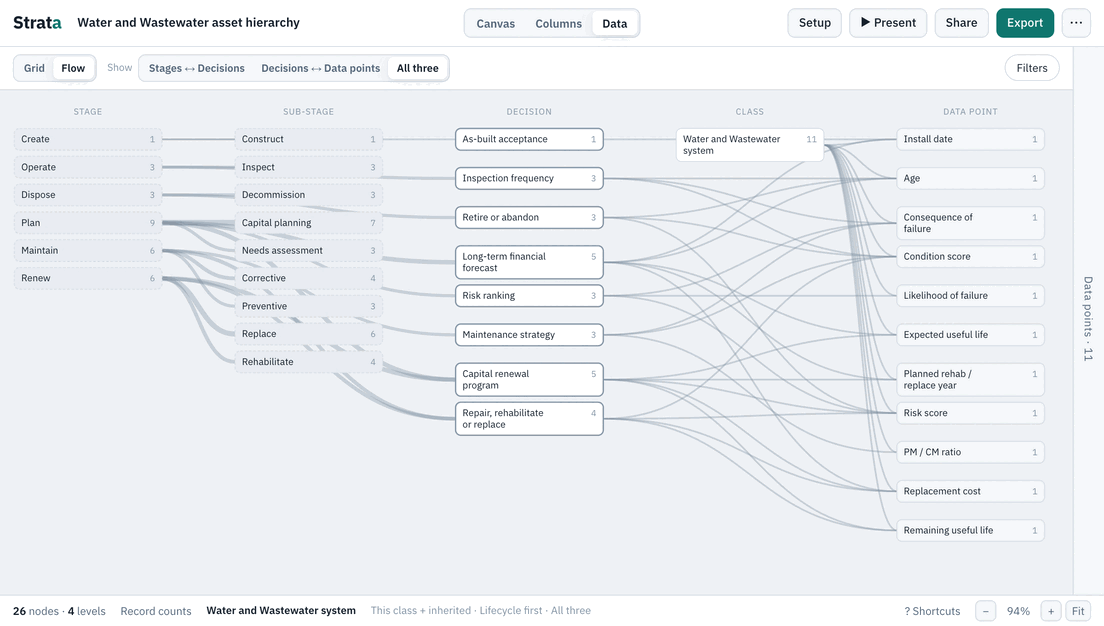
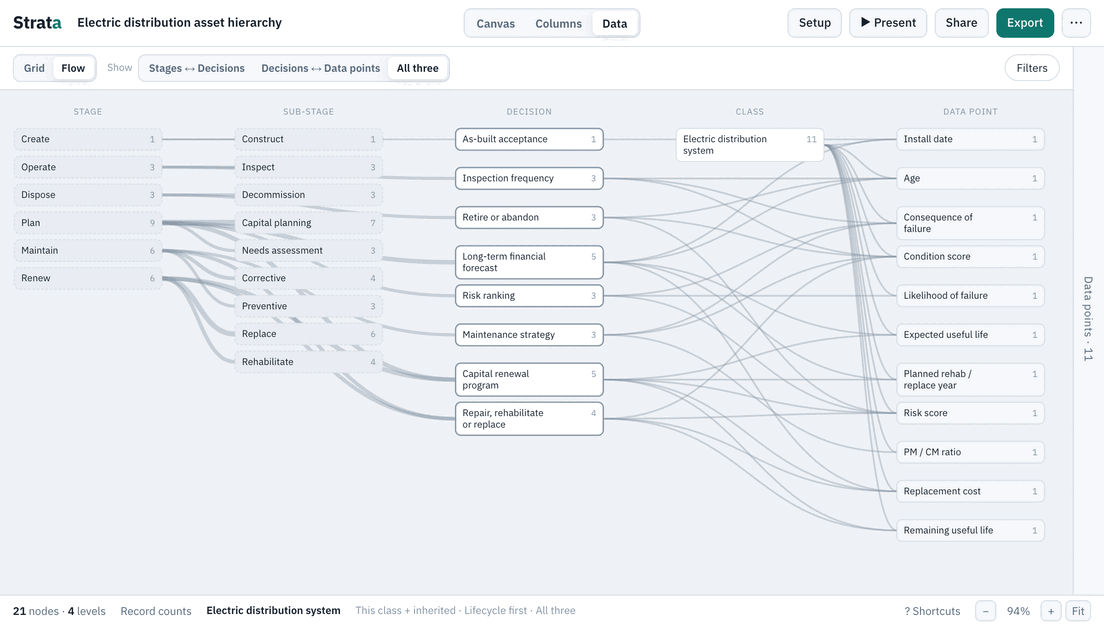
Strata’s templates are about assets, so they speak directly to some attributes and hardly at all to others. Each attribute below is paired with data points and decisions from the Water and Wastewater template and, as a loose parallel, the Electric distribution template. EUM was written for water, so the electric pairing is only an illustration.
The ten attributes, and where asset data comes in
01Product Quality
Delivering water that meets health rules and what customers expect of it, and returning treated wastewater that meets its permit.
Water and WastewaterData points Turbidity, Permit effluent limit.Decisions Process monitoring.
Electric. No close match.
Electric service quality (voltage, flicker) is not described in the electric template.
02Customer Satisfaction
Providing reliable service, answering problems quickly and keeping customers informed.
Water and WastewaterData points Break count (10 years).Decisions Main break response.
Electric distributionData points Fault count (5 years).Decisions Outage restoration priority.
03Employee and Leadership Development
Recruiting, keeping and growing a capable workforce, and preparing the next leaders.
Water and Wastewater. No close match.
Electric. No close match.
This is about people, not assets, so neither template holds asset data for it.
04Operational Optimization
Running the system efficiently: getting the most service from the energy, labor and equipment it uses.
Water and WastewaterData points Wire-to-water efficiency, Run hours.Decisions Pump overhaul timing, Maintenance strategy.
Electric distributionData points Peak loading, PM / CM ratio.Decisions Transformer loading review, Maintenance strategy.
05Financial Viability
Understanding the full cost of service and setting rates and budgets that cover it, now and for renewal later.
Water and WastewaterData points Replacement cost, Planned rehab / replace year.Decisions Long-term financial forecast, Capital renewal program.
Electric distributionData points Replacement cost, Planned rehab / replace year.Decisions Long-term financial forecast, Capital renewal program.
06Infrastructure Stability
Knowing the condition of the pipes, plants and wires, and planning repair and replacement so the system does not wear out faster than it is renewed.
Water and WastewaterData points Condition score, Remaining useful life, Risk score.Decisions Pipe renewal priority, Repair, rehabilitate or replace.
Electric distributionData points Condition score, Remaining useful life, Remaining strength.Decisions Pole replacement priority, Repair, rehabilitate or replace.
07Operational Resiliency
Being able to withstand and recover from failures and shocks, by knowing what matters most and what could go wrong.
Water and WastewaterData points Consequence of failure, Likelihood of failure.Decisions Risk ranking, Main break response.
Electric distributionData points Consequence of failure, Likelihood of failure.Decisions Reliability improvement plan, Vegetation management cycle.
08Community Sustainability
Being a good neighbor: protecting public health and the local environment, and supporting the community’s long-term wellbeing.
Water and WastewaterData points Lead status, Permit effluent limit.
Electric. No close match.
Much of this attribute is about community life beyond the asset register. The data points here cover only the parts that are asset facts.
09Water Resource Sustainability
Protecting and using water sources wisely, including by losing less of what is treated and caring for what is returned to the environment.
Water and WastewaterData points Break count (10 years), Permit effluent limit.Decisions Process monitoring.
Electric. No close match.
This attribute is specific to water, so there is no electric counterpart.
10Stakeholder Understanding and Support
Making sure customers, boards, regulators and partners understand what the utility does and what it costs, and back it.
Water and WastewaterDecisions Capital renewal program, Risk ranking.
Electric distributionDecisions Capital renewal program, Risk ranking.
This is less a data attribute than a conversation. These are the decisions stakeholders usually ask to see explained, and a shared link or a deck is how Strata helps.
Terms are defined in the asset data glossary, and the stages decisions sit in are explained in lifecycle stages and PCOAR.
Related guides
- What is an asset hierarchy? The pillar: levels, classes and instances, common patterns, and the mistakes to avoid.
- Asset data glossary Plain definitions of the terms the templates use.
- Data readiness for analytics Start from the decision, and find the data you are missing.